Text, Gold jewelry from Tell el-Ajjul
European Museums, The British MuseumGold jewelry from Tell el-Ajjul. MBIIC (1650-1550 B.C.) During the latter part of the Middle Bronze Age, Tell el - Ajjul in southern Canaan, fell within the Hyksos sphere of influence. The city of Stratum II was founded around 1670 B.C., and included a place-fort constructed using Egyptian techniques. It was destroyed in about 1570, most probably by Ahmose following his expulsion of the Hyksos from Egypt and the destruction of their capital Avaris. In the ruins of the city, a number of hoards of jewelry were found. The jewelry is strongly Egyptian in style, but shows in its sophisticated techniques of repousse and granulation, considerable skill and refinement, typical of Canaanite craftsmanship of this period. For the most part, the jewelry consists of earrings and pendants. The large plaque is thought to represent the Canaanite goddess of fertility, Astarte, and the small fly was an Egyptian military decoration awarded for valor.
Featured in the picture(s):
Gold jewelry from Tell el-Ajjul, sun symbol, cross with rays
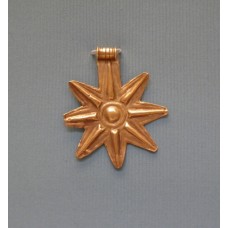
A solar disc pendant from Tell el-AjjulGold jewelry from Tell el-AjjulMBIIC (1650-1550 B.C.)During...
Read moreGold jewelry from Tell el-Ajjul, earrings with cross
-228x228.JPG "Gold jewelry from Tell el-Ajjul, earrings with cross")
Earring with a cross design on the gold jewelry from Tell el-AjjulGold jewelry from Tell...
Read moreGold jewelry from Tell el-Ajjul, crescent earrings
-228x228.JPG "Gold jewelry from Tell el-Ajjul, crescent earrings")
Crescent earring of the gold jewelry from Tell el-AjjulGold jewelry from Tell el-AjjulMBIIC...
Read moreGold jewelry from Tell el-Ajjul, discs, winged man
-228x228.JPG "Gold jewelry from Tell el-Ajjul, discs, winged man")
Bird and solar disc pendant gold jewelry from Tell el-AjjulGold jewelry from Tell el-AjjulMBIIC...
Read moreClick here: thesimpleanswers.com/the-true-cross/
