Text, Ottonian ivory and brooches
European Museums, The British MuseumOttonian ivory and brooches Ottonian art was notable for its luxury and exquisite craftsmanship. The ivory panel, from a church altar or pulpit, may have been backed by gold that would have glinted through the open-work design. The five opulent brooches are enriched with pearls, gems, filigree (beaded wire) and cloisonne enamel set into gold cells. The oval-shaped brooch is inlaid with a cameo inscribed in Greek, wishing luck to the wearer. A.D. 900s-1000s. Magdeburg Cathedral, Germany, attributed at Milan, Italy, 1856,0623.25. Near Dowgate Hill, London, 1856,0701.1461. Possibly from Italy, 1872,0604.761. Bequeathed by Sir Augustus Wollaston Franks, AF.352. Charles Townley collection, 1814, O.A. 4821. Italy, 1887,0513.1 The Norman Conquest and the end of Anglo-Saxon England The first two coins show the last Anglo-Saxon kings of England, Edward the Confessor (1042-1066) and Harold II (1066). The last coin depicts the first Norman King of England, William the Conqueror (1066-1087). Willi
Ottonian Ivory. Raising of the Widow of Nain's Son. Sunk panel; ivory; carved partly in open-work
Featured in the picture(s):
Ottonian Ivory, Raising of the Widow of Nain's Son, cross
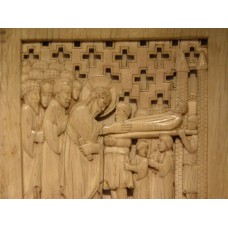
Ottonian Ivory. Raising of the Widow of Nain's Son. Sunk panel; ivory; carved partly in...
Read moreClick here: thesimpleanswers.com/the-true-cross/
