Text, The Uruk Trough
European Museums, The British MuseumThis stone was found at Uruk, the largest city so far discovered in southern Mesopotamia, and dates to about 3300 - 3000 B.C. If it is raised high enough for the relief decoration on its sides to be seen, it cannot easily be used as a trough or basin - it was probably a cult object in the temple of the goddess Inanna. Inanna or Ishtar was the Sumerian goddess of love and fertility and also supreme goddess of Uruk. This object is one of the earliest examples of formal religious art from Mesopotamia. The carving shows sheep approaching a reed hut from which lambs emerge. The meaning of the scene is uncertain, but it probably reflects the fertility of flocks under the protection of Inanna. The high volutes on either side of the hut and elsewhere are symbols of the goddess. Rosettes, depicted on the ends of the trough, also seem to have been associated with Inanna and they feature prominently in Sumerian art. Late Uruk period, 3300 - 3000 B.C. From Uruk. ME120000
Flower-like sun symbol beside a sheep on The Uruk Trough
Featured in the picture(s):
The Uruk Trough, eight-point, flower-like, sun symbol
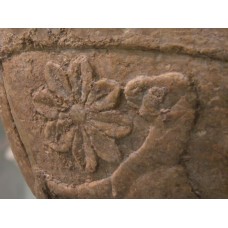
Flower-like sun symbol beside a sheep on The Uruk TroughThe Uruk TroughThis stone was found at...
Read moreThe Uruk Trough, horn-like design
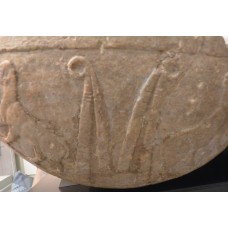
Horn-like design on The Uruk TroughThe Uruk TroughThis stone was found at Uruk, the largest city...
Read moreThe Uruk Trough, sheep approaching a reed hut, lambs emerge
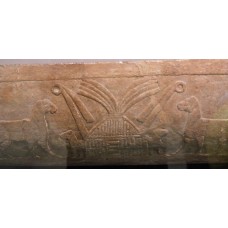
Sheep approaching a reed hut from which lambs emerge on The Uruk TroughThe Uruk TroughThis stone...
Read moreClick here: thesimpleanswers.com/the-true-cross/
