Text, Roof-end tile
National Museum of Korea, Yongsan-gu, Seoul, South KoreaRoof-end tile. Three kingdoms period (Baekje), 4th-5th Century Seokchon-dong Tomb, Seoul. The roof tiles of Baekje establish Baekje's unique style mainly consisting of lotus flower patterns as it goes through the Ungjin and Sabi period. During the Ungjin period, the kingdom of Baekje newly adopted the roof tile production technology of Liang of Southern Dynasties, and the production of roof tiles also gained momentum as many Buddhist temples were built after moving the capital to Sabi. The roof tile production technology of Baekje was introduced to Silla as well as Japan. Dr. Wa who was sent to Japan influenced the development of Asuka roof tiles.
Roof-end tile
Featured in the picture(s):
Roof tiles of Baekje, roof-end tile, solar disc, eight-point

Roof-end tile. Three kingdoms period (Baekje), 4th-5th Century Seokchon-dong Tomb, Seoul. The roof...
Read moreRoof tiles of Baekje, roof-end tile, spiral solar disc

Spiral solar disc, Korea, 5th century. Roof-end tile. Three kingdoms period (Baekje), 4th-5th...
Read moreRoof tiles of Baekje, roof-end tile, solar disc, lotus

Roof-end tile. Three kingdoms period (Baekje), 4th-5th Century Seokchon-dong Tomb, Seoul. The roof...
Read moreRoof tiles of Baekje, roof-end tile, cross in solar wheel

Roof-end tile. Three kingdoms period (Baekje), 4th-5th Century Seokchon-dong Tomb, Seoul. The roof...
Read moreRoof tiles of Baekje, roof-end tile, solar disc, sun symbol
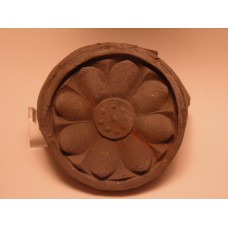
Roof-end tile. Three kingdoms period (Baekje), 4th-5th Century Seokchon-dong Tomb, Seoul. The...
Read moreRoof tiles of Baekje, roof-end tile, eight-point solar disc

Roof-end tile. Three kingdoms period (Baekje), 4th-5th Century Seokchon-dong Tomb, Seoul. The roof...
Read moreClick here: thesimpleanswers.com/the-true-cross/
